
 Facebook
 X
X
 Pinterest
 Copy Link

How much will my house sell for in the Bay Area?
Author: Janice Lee | Last Updated: August, 2026
It depends, and not in the way people usually mean when they say that. Two houses with identical square footage can differ by more than a million dollars depending on which side of a county line they sit on. Your city, your neighborhood, your block, the condition of the place and what sold near you in the last three months all move the number.
Here’s what actually drives it, and how to get a real figure rather than a guess.
Where values sit right now
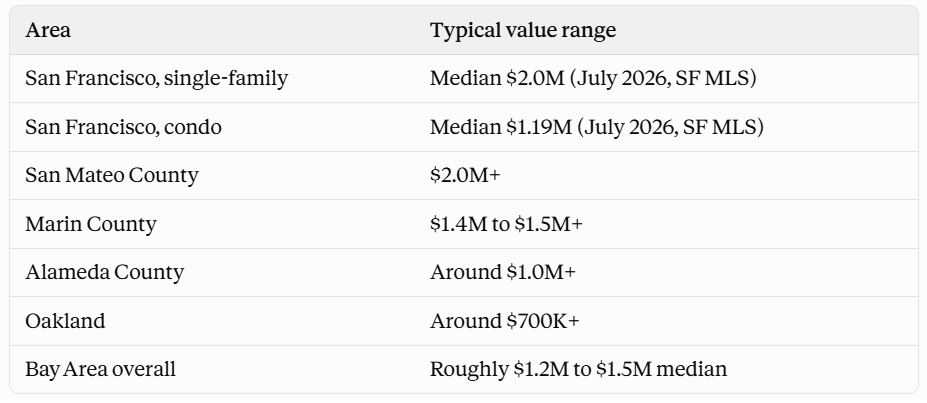
The San Francisco figures come from closed MLS sales in July. The rest are approximate ranges and move constantly, so treat them as orientation rather than a valuation.
Location does most of the work
A renovated house in Palo Alto, Atherton, or Menlo Park can sell for millions more than an equivalent house elsewhere in the region. Within San Francisco the same logic applies at a smaller scale, where one side of a street can price differently from the other.
The neighborhood usually matters more than the house.
Property type changes the math
Single-family homes command the strongest premiums. In San Francisco in July, the median single-family home closed at 125% of its list price, while condos closed at about 100%. That’s a 25-point spread between two property types in the same city in the same month.
Condos face more competition from similar units and generally take longer to sell, though that gap narrowed sharply this year. Multi-family and investment properties get valued on income potential instead, which is a different calculation altogether.
Condition matters, but not the way most sellers think
Updated kitchens, bathrooms, flooring, and curb appeal all drive buyer interest. What doesn’t reliably pay off is the gut renovation. Sellers routinely spend heavily on work that returns less than it cost, and the difference between a smart pre-sale update and an expensive one is worth a conversation before you write the check.
Comparable sales are the real answer
The most accurate way to price anything is to look at what similar homes near you sold for in the last 60 to 90 days. Agents call these comps, and they’re the same thing an appraiser will use when your buyer’s lender orders a valuation.
The word “similar” is doing heavy lifting there. Similar size, similar condition, similar block. A sale three streets over in a different school zone isn’t a comp, whatever the square footage says.
Market conditions right now
The Bay Area remains inventory-constrained and a majority of homes are selling above asking. San Francisco specifically has about 1.4 months of supply, and anything under three months is a seller’s market.
That scarcity is what’s pushing sale prices past list. In a market with normal inventory, the same house sells for less.
Some rough examples
A three-bedroom house in San Francisco often lands between $1.4M and $2.5M or higher, depending heavily on neighborhood. A San Francisco condo tends to run $650K to $1.3M or more. Oakland homes often fall between $700K and $1.2M. In Silicon Valley communities like Sunnyvale or Cupertino, $2M to $3M and up is common.
These are wide ranges on purpose. Anyone giving you a tight number without seeing the property is guessing.
How to get a number you can actually use
For a real estimate, you need seven things: the property address, square footage, bedroom and bathroom count, lot size, year built, any recent upgrades or renovations, and the property type.
With those, a comparative market analysis will beat any online estimator. Zillow and Redfin work from public records and algorithms that can’t see your remodeled kitchen, don’t know your block has a view, and have no idea what’s pending against you right now.
I’ll run one for your property at no cost. Request a home valuation here, or call me at (415) 832-9151 and we can talk through it.
If your property is unusual enough that comps don’t quite fit, a formal appraisal before listing is worth paying for. It gives you a defensible number and documentation to hand a buyer’s lender later.
Frequently asked questions
How much is my house worth in the Bay Area?
It depends on your exact location, condition, and what’s sold nearby in the last 90 days. Regional values run from the high hundreds of thousands to several million.
Are Bay Area prices still rising?
Unevenly. San Francisco and the Peninsula have seen real appreciation this year, with the SF single-family median up 21.5% from July 2025. Parts of the East Bay have stayed flat or softened.
Do homes still sell above asking?
Yes, frequently. In San Francisco the median single-family home closed 25% over list in July. Condos closed closer to asking.
Should I get an appraisal before selling?
A comparative market analysis is the starting point and it’s free. A formal appraisal is worth the cost when your property is unusual or when you want documentation to support your price.
What’s the fastest way to find out what my home is worth?
Ask a local agent for a comparative market analysis. It takes a day or two and costs nothing.
The bottom line
Most Bay Area homeowners are holding something valuable. The gap between an average sale and a strong one is often several hundred thousand dollars, and it comes down to pricing correctly at the start rather than discovering the right number through reductions.
